Religious Symbols in Jewelry: Their Meanings, History and Ancient Signs
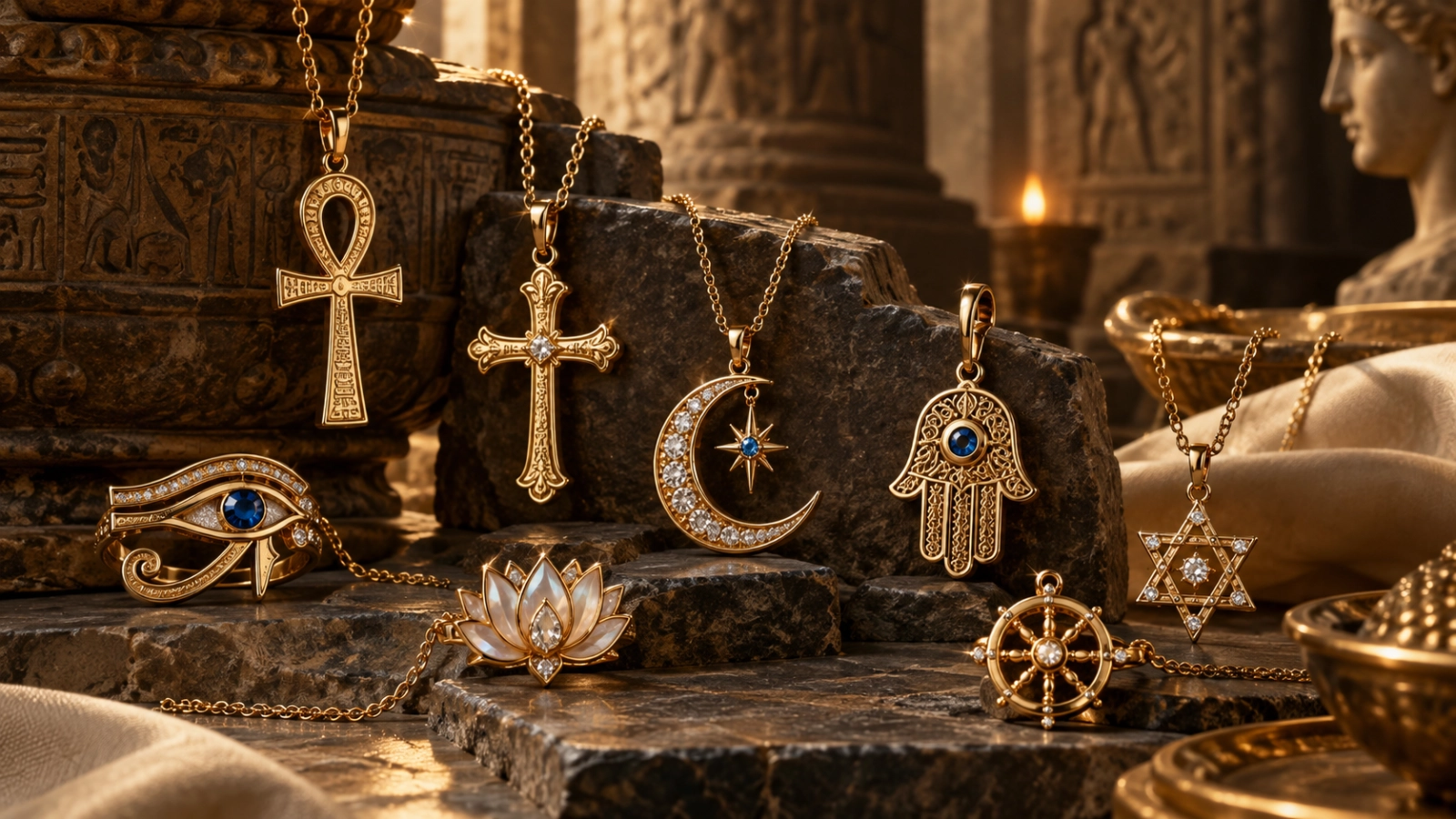
A small cross hanging from a necklace, an eye motif on a ring, a crescent on an earring, or an Ankh whose story reaches back thousands of years… Many of the symbols we wear in jewelry today may appear to be purely aesthetic details, yet they actually carry much older stories.
Religious symbols, ancient signs and protective motifs have been used throughout human history to express concepts such as faith, belonging, protection, life, death, rebirth, luck and identity. While some became strongly associated with particular religions over time, others acquired different meanings across multiple cultures.
For this reason, it is not always possible to explain the modern meaning of a symbol simply by looking at its shape. For example, the cross-like Ankh is not related to Christianity; the crescent appeared in jewelry long before Islam; and the six-pointed star was used as a geometric motif in various cultures before becoming strongly identified with Judaism as the Star of David.
Important: The meanings of symbols can vary according to period, geography and community. Wearing a symbol does not necessarily mean that a person belongs to that religion or belief system. However, some symbols still carry very strong religious and cultural associations today.
1. Why Have People Worn Symbols as Jewelry for Thousands of Years?
In the earliest periods of jewelry history, necklaces, rings and bracelets were not worn solely for decoration. People also attributed protective or symbolic meanings to the small objects they carried on their bodies.
Amulets from Ancient Egypt, moon and sun motifs from the Roman period, hand-shaped protective objects from the Middle East and religious pendants used in later periods are all examples of this tradition.
The fact that jewelry is worn close to the body also gives it symbolic importance. A necklace worn around the neck, a ring on the hand or a bracelet on the wrist can represent its owner's identity, faith, family, social status or personal story.
Today, however, the same symbol may be chosen for completely different reasons. One person may wear a cross necklace because of religious faith, while another may choose it for a Gothic fashion aesthetic. Someone else may wear an Ankh necklace because of an interest in Ancient Egyptian history.
Therefore, when examining the meanings of symbols in jewelry, it is important to consider both their historical origins and the ways in which they are used today.
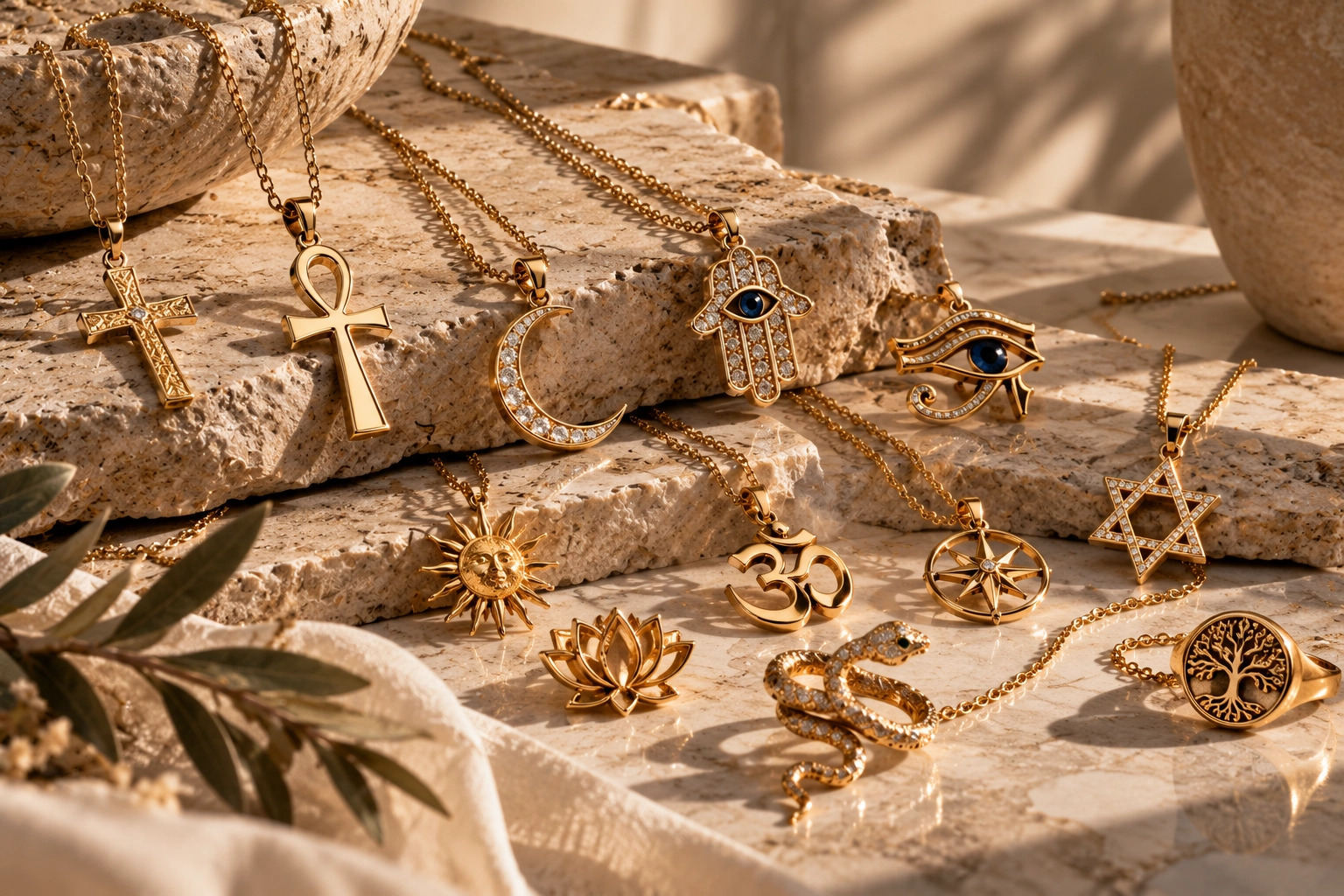 2. The History of the Cross: Did Cross Symbols Exist Before Christianity?
The cross is one of the most easily recognized religious symbols in the world today, and the Latin cross in particular is strongly associated with Christianity.
However, there is an important distinction: cross-shaped geometric signs are much older than Christianity. Simple forms consisting of two intersecting lines can be found on artifacts from Antiquity and even earlier periods, where they were used for various purposes.
This does not mean that ancient cross-shaped signs were “Christian crosses.” The meaning of the cross in Christianity developed in connection with the crucifixion of Jesus and later with ideas of victory over death, salvation and eternal life.
Especially during the early Byzantine period, the cross was widely used not only in places of worship but also in homes, on clothing and in jewelry such as pendants.
What Does Cross Jewelry Mean?
For Christians, a cross necklace often represents faith, Christ, salvation or spiritual devotion. During certain historical periods, cross-shaped jewelry was also attributed protective meanings.
Today, the cross is also a powerful design element in the fashion world. Cross motifs frequently appear in rock, punk, Gothic and high-fashion collections.
For this reason, a non-Christian person can also wear a cross. However, even when the intention is purely fashion-related, the Latin cross still carries a very strong Christian association. People who see the jewelry may interpret it as a religious symbol.
Are All Crosses the Same?
No. There are many different forms, including the Latin cross, the Greek cross with arms of equal length, the Celtic cross, the Jerusalem cross and the Maltese cross. Although these shapes can sometimes look similar, their histories and the communities in which they have been used are not the same.
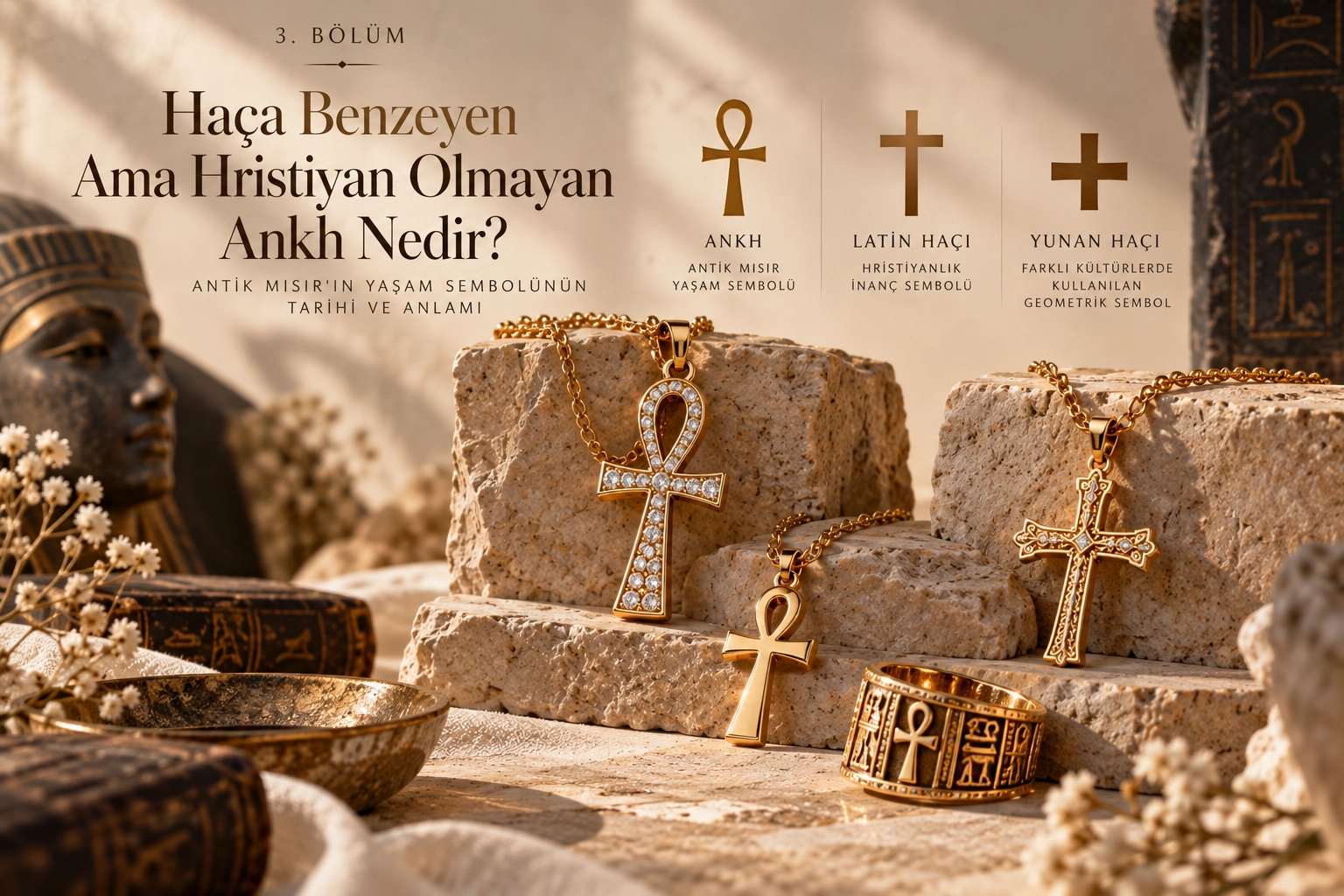 3. What Is the Ankh, Which Looks Like a Cross but Is Not Christian?
One of the symbols most frequently confused with the cross in jewelry design is the Ankh.
The upper part of the Ankh contains an oval or loop-shaped element. Its lower section consists of vertical and horizontal lines resembling a cross. For this reason, at first glance it may appear to be a differently designed cross.
However, the Ankh originates in Ancient Egypt and predates Christianity by thousands of years.
In the Ancient Egyptian hieroglyphic system, the Ankh was associated with concepts such as “life,” “to live” and “to be alive.” Over time, it became one of the most recognizable Ancient Egyptian symbols representing life itself.
Egyptian art sometimes depicts gods holding the Ankh or presenting an Ankh to a ruler. As a result, the symbol became associated with life force, continuity and existence.
What Does an Ankh Necklace Mean Today?
Today, Ankh necklaces are not worn only by people interested in Ancient Egyptian history. They may also be chosen to represent life, rebirth, continuity, personal strength or an interest in ancient cultures.
Therefore:
Latin Cross → Strongly connected with Christianity.
Ankh → The Ancient Egyptian symbol of life.
Although they may look similar, their historical origins and fundamental meanings are different.
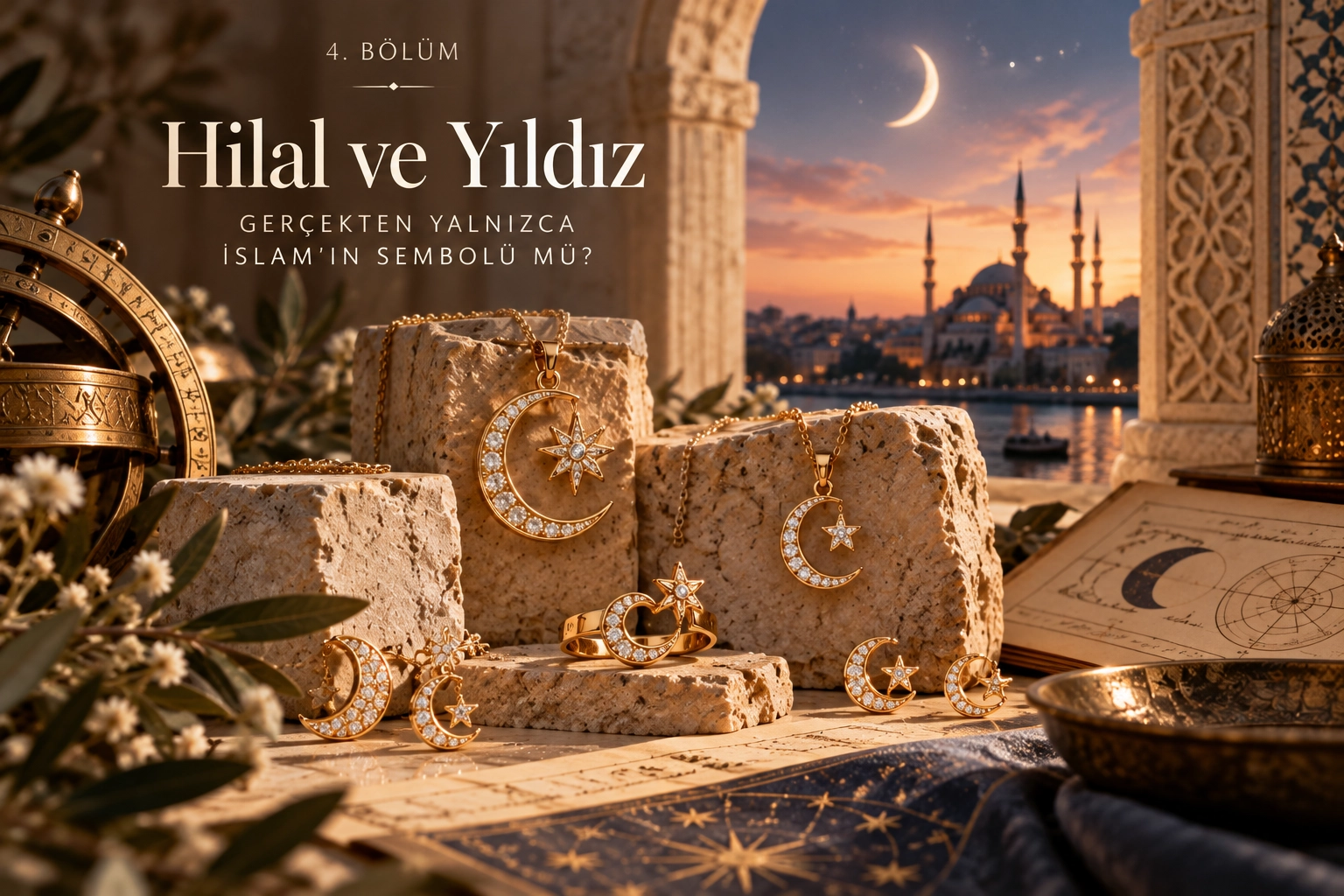 4. The Crescent and Crescent-Star: Are They Really Symbols of Islam Only?
The crescent is one of the symbols most strongly associated with the Islamic world today. However, the history of the crescent is much older than the emergence of Islam.
Because the moon is one of the celestial bodies observed by humans since ancient times, it has been associated in different civilizations with fertility, time, night, change and various deities.
Even jewelry surviving from the Roman period includes crescent-shaped gold pendants. In some Roman jewelry, the crescent represented the moon, while circular or wheel-like motifs represented the sun.
During later periods of Islamic history, the crescent became increasingly visible in the symbolic traditions of Muslim states. The use of the crescent and star by the Ottoman Empire also contributed to their strong modern association with Islam.
Therefore, it is historically inaccurate to say that “the crescent belongs exclusively to Islam.” However, it should also be remembered that the crescent or crescent-and-star motif is perceived by many people today as an Islamic symbol.
For the same reason, an ordinary moon necklace and a crescent motif used with a religious association may not always have the same meaning. Context is decisive.
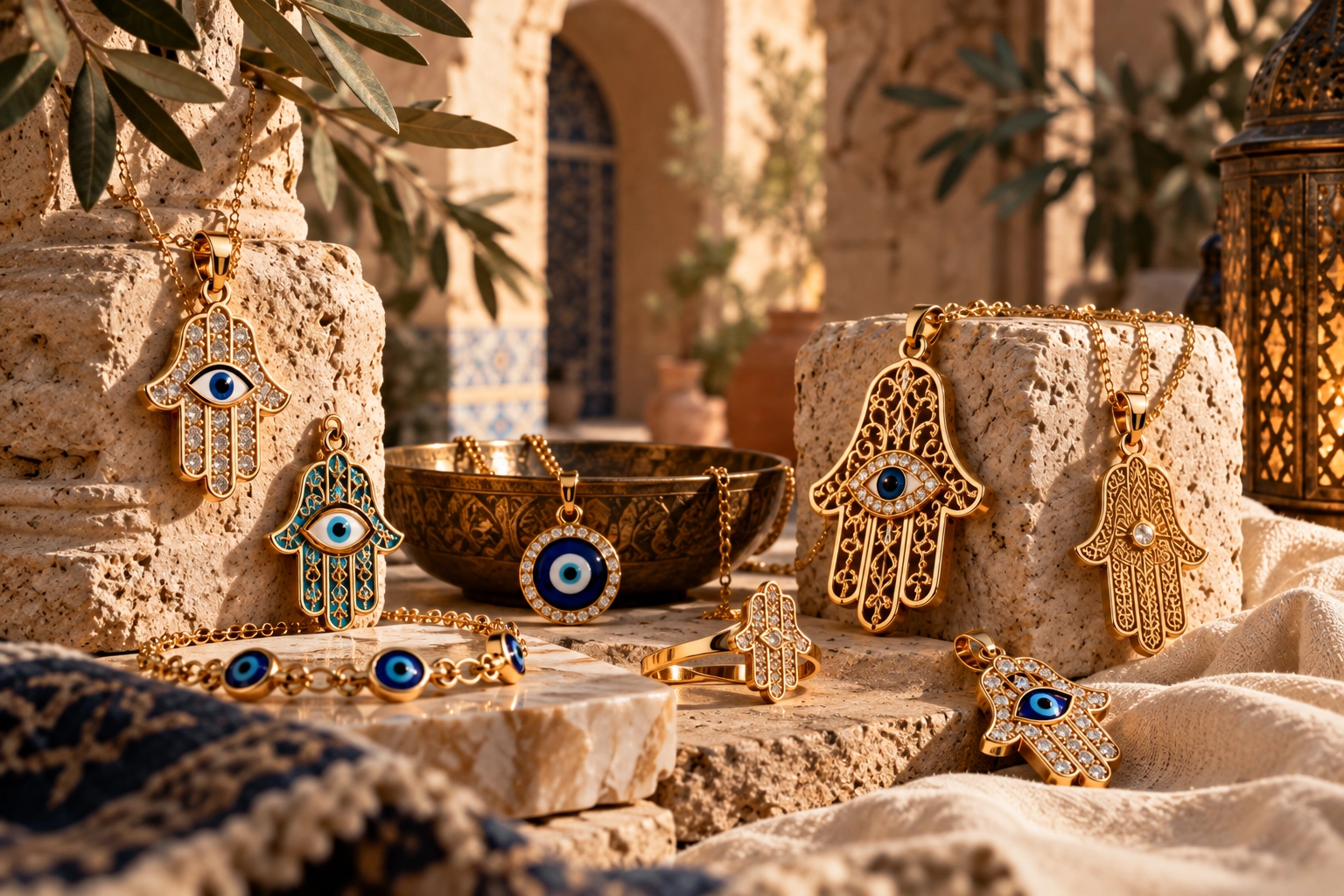 5. Hamsa, the Hand of Fatima and the Hand of Miriam: Can One Symbol Belong to More Than One Religion?
One of the most widely used protective symbols in jewelry is the hand figure known as the Hamsa or Khamsa.
Associated with the Arabic word meaning “five,” the Hamsa has long been used as a protective amulet throughout the Middle East and North Africa.
In Muslim communities, the symbol is frequently known as the Hand of Fatima, a name associated with Fatima, the daughter of the Prophet Muhammad.
However, the Hamsa does not belong exclusively to Muslim communities. Historical examples show that hand-shaped amulets were also used by Jewish communities as protection against the evil eye or the “envious eye.” In some Jewish traditions, the symbol is also known as the “Hand of Miriam.”
This is one of the clearest examples of how a symbol can be shared among different cultures over time.
Are the Hamsa and the Evil Eye the Same Thing?
No. The Hamsa is a hand symbol, while the evil eye is an eye-shaped protective motif. However, the two are frequently combined in modern jewelry, with an eye figure placed in the palm of the Hamsa.
If you like jewelry featuring eye motifs, modern designs such as Aulin's Cubic Zirconia Evil Eye Earrings show how this ancient eye theme has been reinterpreted in contemporary jewelry design.
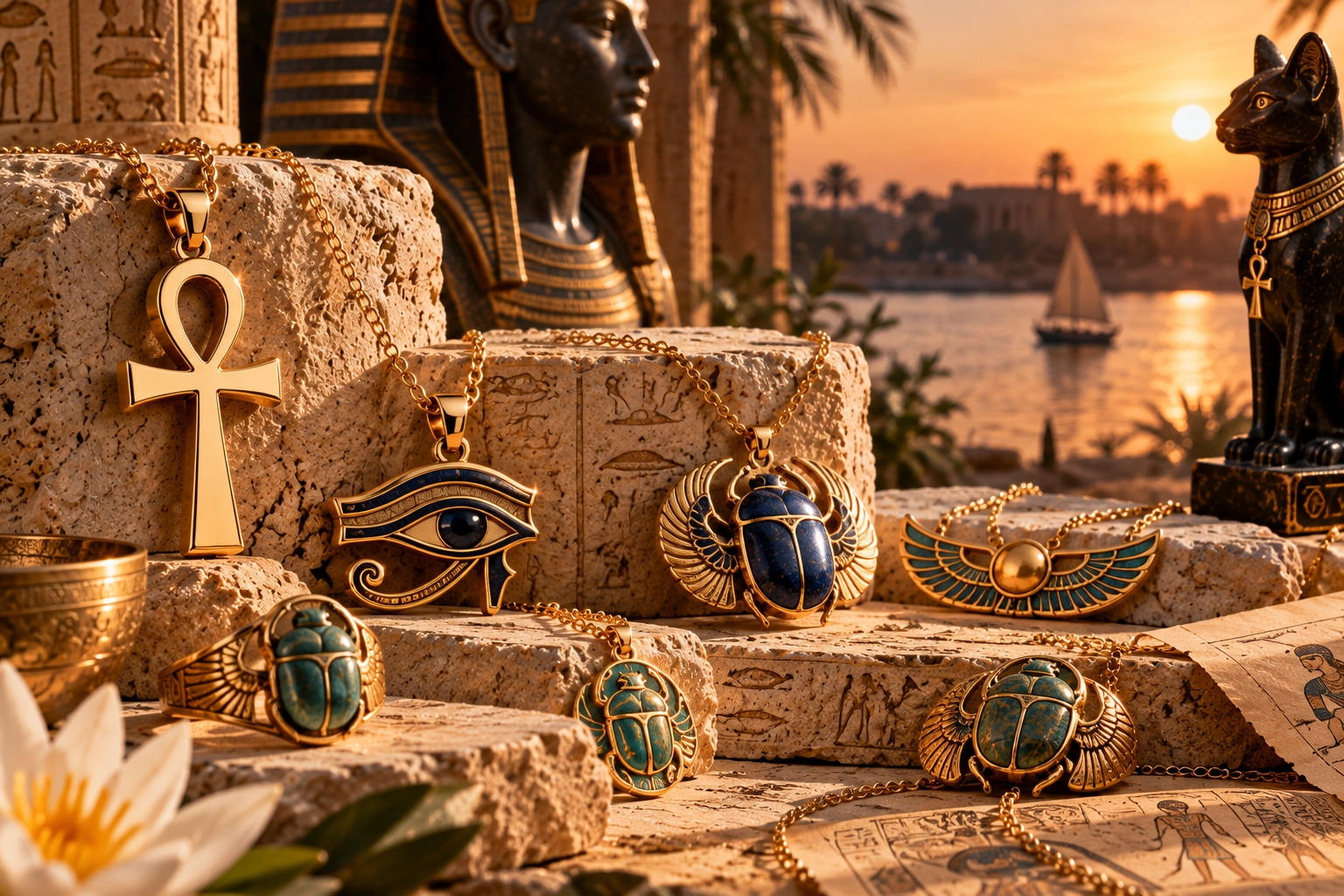 6. The Eye of Horus, Evil Eye and Scarab: Protective Symbols of Ancient Egypt
The eye motif appears in many cultures throughout different periods of history. However, not every eye symbol has the same origin.
Eye of Horus / Wedjat Eye
The Eye of Horus is one of Ancient Egypt's most recognizable symbols and is also known as the “Wedjat.”
Because Egyptian mythology tells of Horus's eye being damaged and later restored, the symbol gradually became associated with ideas of healing, protection and restoration to wholeness.
Small amulets shaped like the Eye of Horus were used in Ancient Egypt both by living people and in rituals associated with the dead.
Are the Evil Eye and Eye of Horus the Same?
No. They may be confused because both visually represent an “eye,” but their histories are different.
The Eye of Horus originates in Ancient Egyptian mythology. The evil eye, by contrast, belongs to much broader traditions surrounding the evil eye and protective eye motifs across the Eastern Mediterranean, Anatolia, the Middle East and surrounding regions.
Therefore, it would not be accurate to describe a modern evil eye bead or evil eye earring directly as the “Eye of Horus.”
What Does the Scarab Beetle Symbolize?
Another symbol frequently encountered in Ancient Egyptian jewelry is the scarab beetle.
Ancient Egyptians associated the movements of the scarab beetle with the sun's journey across the sky. Linguistic connections between the Egyptian name for the beetle and words associated with “coming into being” or “becoming” also strengthened its symbolic meaning.
For this reason, scarab amulets gradually became associated with ideas of renewal, rebirth and existence. They were used in rings, seals and pendants.
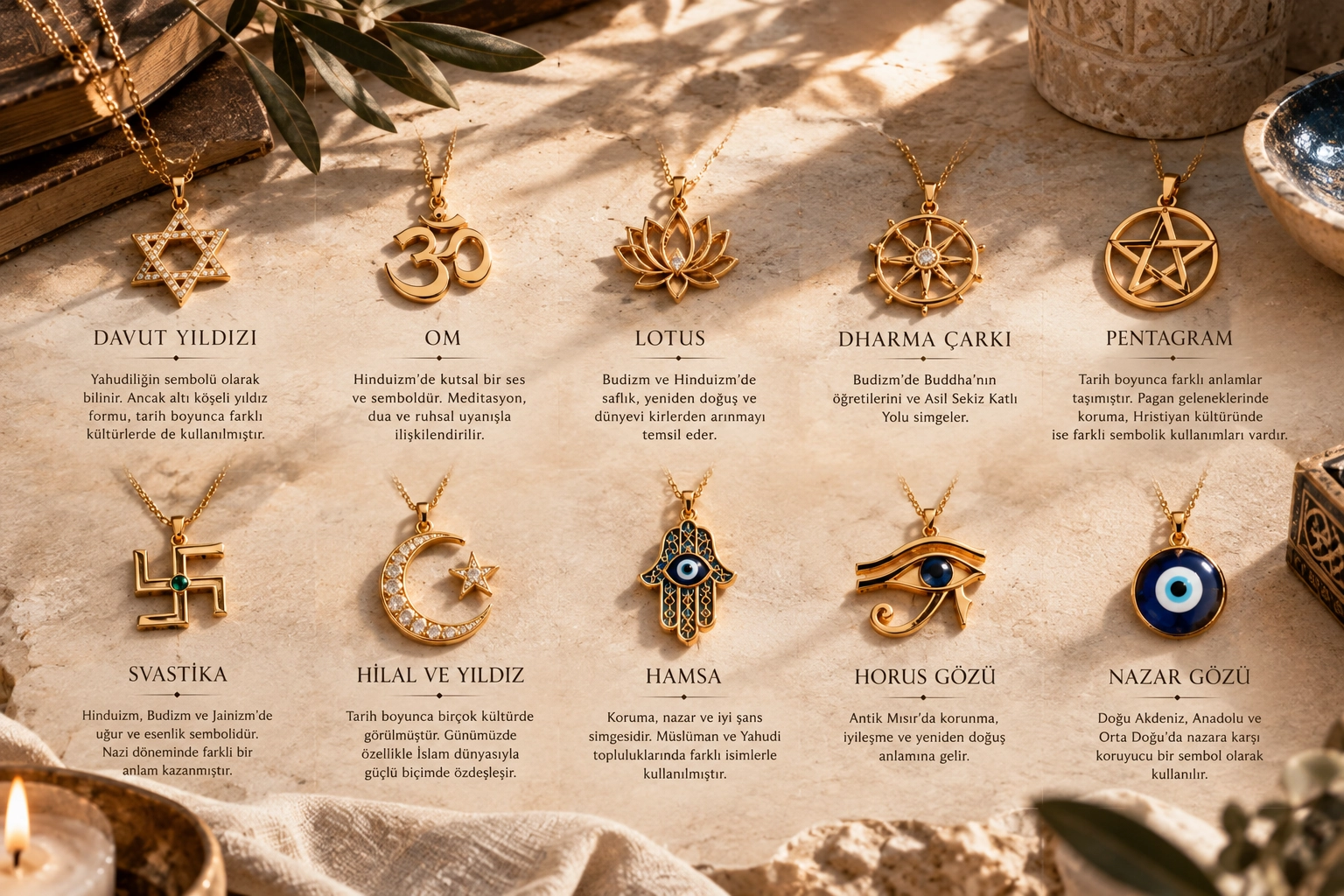 7. What Do the Star of David, Om, Lotus, Dharma Wheel and Pentagram Mean?
Religious and spiritual symbols used in jewelry are not limited to Christianity, Islam or Ancient Egypt.
Star of David
The six-pointed star created by overlapping two equilateral triangles is today known as the Star of David or Magen David and is one of the most recognizable symbols of Judaism and Jewish identity.
However, the history of the six-pointed geometric motif is not limited to Jewish use. The hexagram form has also appeared in different cultures as a decorative, mystical or geometric sign.
The strong and widespread identification of the Star of David with Jewish identity became more pronounced during later historical periods.
Therefore, six-pointed star jewelry today may strongly evoke Judaism, while it would be inaccurate to say that every geometric hexagram throughout history belonged exclusively to Judaism.
Om
Om or Aum is a sacred sound, syllable and symbol, particularly within Hindu traditions. It has an important place in meditation, prayer and religious practice and may also appear in different contexts in Buddhist and Jain traditions.
Because Om is now frequently used as a motif in necklaces, rings and tattoos within yoga and wellness culture, it may sometimes be mistaken for a purely decorative symbol. However, it is important to remember that it is still considered sacred within living religious traditions.
Lotus
The lotus flower carries powerful symbolic meanings in many Asian traditions. In Buddhism, because it rises from muddy water and blooms as a clean flower, it is associated with purity, awakening and rising above worldly impurities without being contaminated by them.
The lotus also appears in Hindu traditions and in much older Egyptian art, although its meaning is not exactly the same in every culture.
Dharma Wheel
The Dharma Wheel or Dharmachakra, resembling a wheel with multiple spokes, is one of the most important symbols in Buddhism representing the teachings of the Buddha.
Its eight-spoked form is frequently associated with Buddhism's Noble Eightfold Path.
Pentagram
The pentagram, formed by continuously connecting the lines of a five-pointed star, does not have a single universal meaning either.
Throughout history it has been used in mathematical, philosophical, religious and esoteric contexts. There are even examples of the pentagram carrying various positive symbolic meanings within medieval Christian culture.
Therefore, it is historically inaccurate to describe the pentagram exclusively as a “satanic symbol.” Today, its orientation, accompanying signs and cultural context can significantly influence how it is perceived.
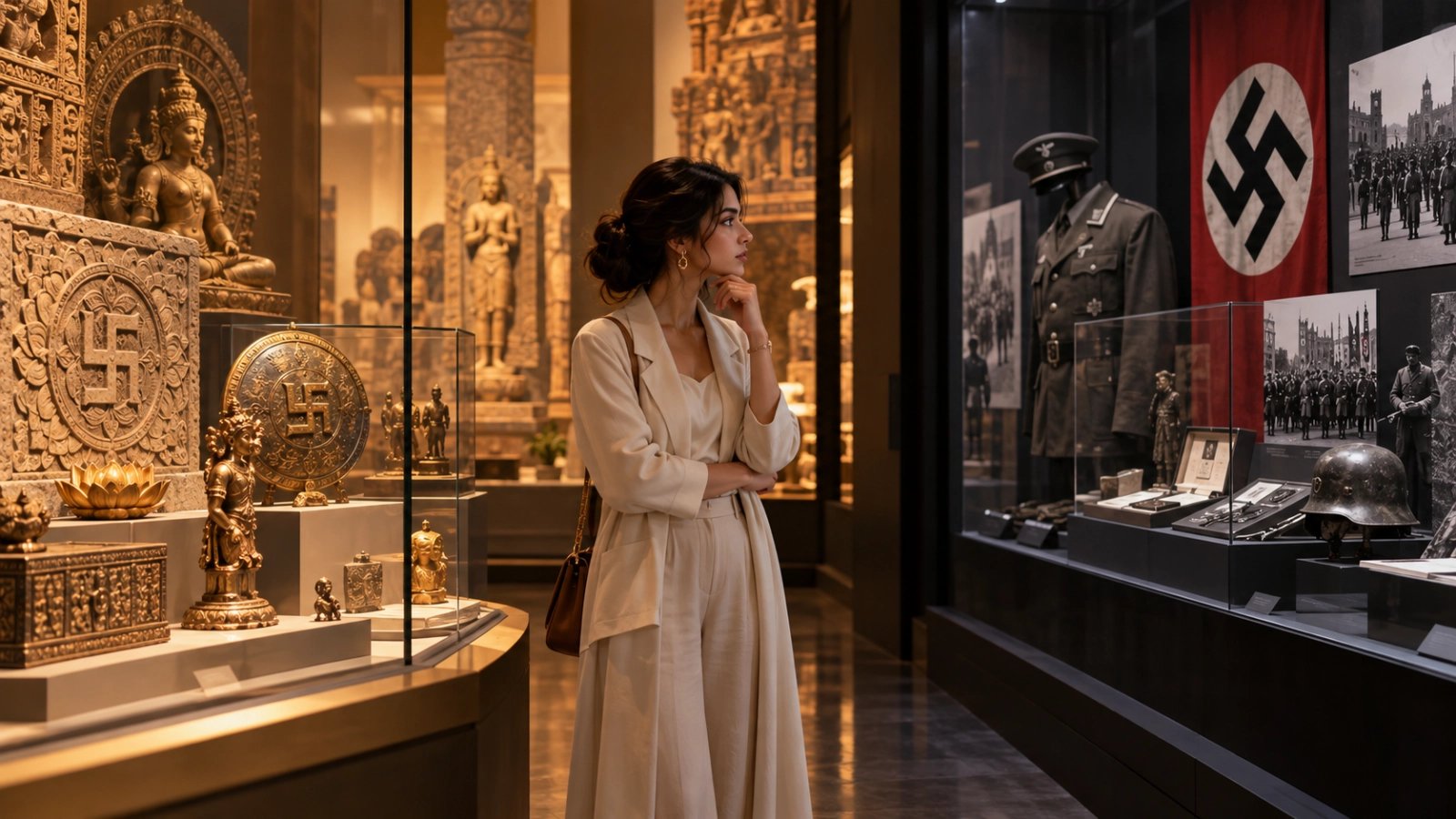 8. The Swastika: How Can the Meaning of an Ancient Symbol Change Completely?
One of the most striking examples in the history of symbols is the swastika.
The swastika is an ancient sign that appeared in many regions of the world thousands of years before Nazi Germany. Particularly in Indian-origin religious traditions such as Hinduism, Buddhism and Jainism, it has been associated with good fortune, well-being, prosperity or sacredness, and it continues to be used within these traditions today.
However, in the 20th century, the Nazi movement adopted this ancient symbol as an emblem of its ideology, radically changing its meaning, particularly in Europe and the Western world.
Because of the Holocaust and the crimes committed by the Nazi regime, the swastika is today extremely strongly associated in the Western world with Nazism, antisemitism and white supremacist ideologies.
Therefore, seeing the same shape in a Hindu temple in India and seeing it at a far-right demonstration in Europe do not carry the same cultural meaning.
The important lesson here: The meaning of a symbol should be evaluated not only by its shape, but also by where, when and by whom it is being used.
9. Do Similar-Looking Symbols Have the Same Meaning?
One of the most common mistakes regarding symbols in jewelry is assuming that similar-looking shapes have the same origin.
Cross and Ankh: They are visually similar, but while one is strongly associated today with Christianity, the other is an Ancient Egyptian symbol of life.
Evil Eye and Eye of Horus: Both use the eye motif, but their historical origins are different.
Crescent and Moon Jewelry: The same geometric form may simply represent the moon in one design while carrying a strong religious or cultural association in another context.
Star of David and Hexagram: The same six-pointed geometric form has appeared in different cultures throughout history; today, however, its use as the Magen David is strongly associated with Jewish identity.
Five-Pointed Star and Pentagram: Not every five-pointed star is a pentagram. A pentagram is a specific geometric form in which the lines are interconnected, and it has not carried only one meaning throughout history.
Can You Wear a Religious Symbol Without Belonging to That Religion?
In today's fashion world, the cross, Ankh, Hamsa, crescent, eye, lotus, Om and many other historical symbols are used as design elements in necklaces, earrings, rings and bracelets.
Therefore, wearing a particular symbol does not automatically mean that a person belongs to that religion or belief system.
However, a symbol can also carry a social meaning independent of the wearer's intention.
For example, a person may wear a Latin cross simply because they like its design, yet people around them may still associate the necklace with Christianity. The same can apply to the Star of David, Om and certain other religious symbols.
For this reason, when choosing symbolic jewelry, looking not only at its appearance but also at its history, cultural meaning and what it represents to living communities allows the jewelry to be worn in a much more informed way.
Why Do Symbols Still Give Jewelry Such a Powerful Character?
The world of people who wore scarab rings, Hamsa necklaces or eye amulets thousands of years ago was very different from ours. Yet the human desire to give jewelry meaning has not changed.
Even today, a ring may be more than just a ring. A star can represent hope or guidance, an eye the idea of protection, a snake transformation and renewal, a moon change, a cross faith and an Ankh life.
Aulin also offers pieces that bring symbolic motifs together with contemporary jewelry design. For example, the Star Dangle Mixed-Design Chain Necklace brings the star motif into a modern necklace design, while the Wide Statement Ring with Star Motif and Cubic Zirconia Details interprets the same symbol in a bolder form.
Those interested in contemporary interpretations of the snake motif can also explore the Women's Red-Eyed Snake Ring with Cubic Zirconia.
Because what makes jewelry interesting is not only its metal, stone or form. Sometimes a small symbol continues to carry a story thousands of years old around your neck, on your ear or on your finger.
Which symbol do you enjoy wearing the most?